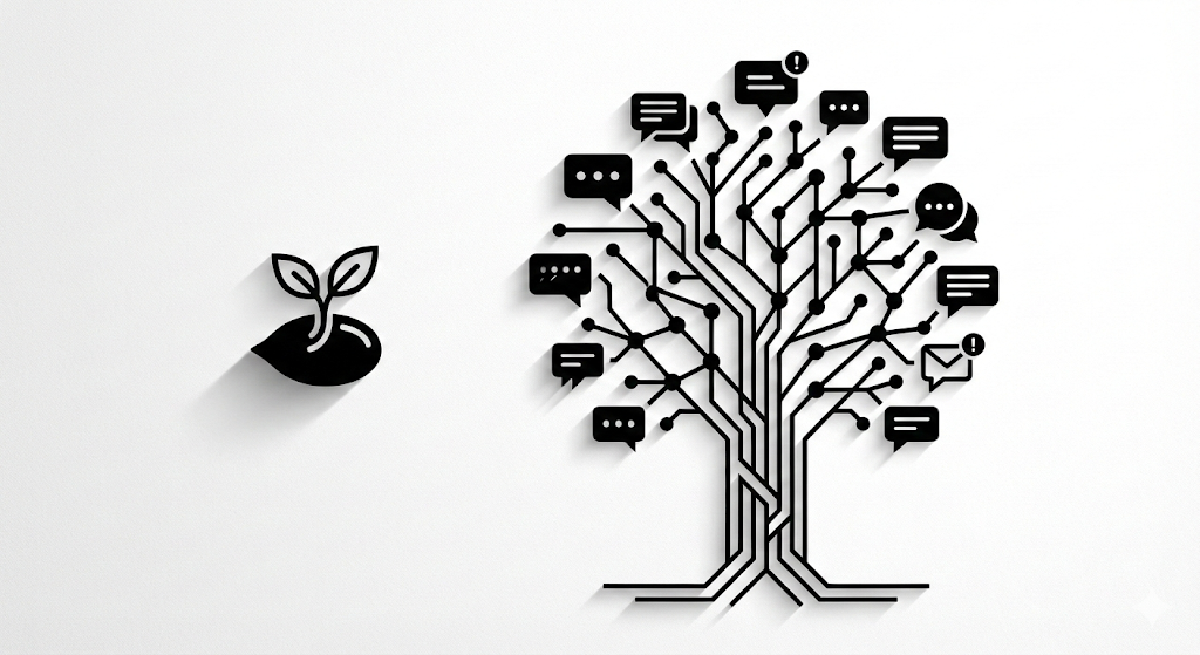

A source code analysis of 68 releases (v0.1.0 → v2026.3.1), tracing an AI product’s real journey from 0 to 1.
Introduction#
In November 2025, a project called warelay quietly came into existence. Four months later, it became OpenClaw—an AI Agent platform supporting 8 messaging channels, native apps on three platforms, and sub-agent collaboration.
This isn’t a story of a grand architecture being designed upfront and filled in later. This is a product evolution that grew from a 400-line WhatsApp relay script.
I analyzed all 68 releases of OpenClaw from its first commit to the latest version, tracking approximately 1.5 million lines of code changes, trying to answer one question:
How does an AI product find itself?
Chapter 1: Tool Phase—“Just Make the Messages Forward”#
v0.1.0: The Birth of warelay#
On November 25, 2025, the project was released under the name warelay (WhatsApp relay).
{
  "name": "warelay",
  "description": "WhatsApp relay CLI (send, monitor, webhook, auto-reply) using Twilio"
}
The positioning was crystal clear: a command-line tool for WhatsApp message relay.
Core capabilities:
- Send WhatsApp messages via Twilio API
- Connect directly to WhatsApp Web via Baileys library
- Receive inbound messages via Webhook
- Configuration-driven auto-reply
Code size: 4,227 lines (excluding tests).
The architecture was extremely simple:
CLI entry → Command parsing → Twilio/Baileys call → Return resultNotably, even in this earliest version, there was a key design: Dual Provider Strategy.
// v0.1.0 provider selection logic
export function pickProvider(explicit: Provider | "auto"): Provider {
  if (explicit !== "auto") return explicit;
  return webAuthExists() ? "web" : "twilio";
}
This seemingly simple abstraction laid the groundwork for later multi-channel expansion.
v0.1.1 - v0.1.3: Polish Phase#
The next three versions were typical “make it actually work” releases:
- v0.1.1: Fix npx execution failure (ESM entry issue)
- v0.1.2: Fix Commander.js type errors
- v0.1.3: Introduce pino structured logging
The common theme: no new features, all fixes and polish.
An interesting detail: v0.1.2 changed only 15 lines of code, but it revealed a process issue—v0.1.1 shipped with type errors, indicating no CI gate at the time. This was fixed in later versions.
Tool Phase Insights#
At this point, warelay had no concept of “AI Agent.” It was just a message middleware. The user’s mental model was:
“I need a tool to help me relay WhatsApp messages.”
This positioning was simple, clear, and verifiable.
Chapter 2: Agent Phase—“Let AI Act Proactively”#
v1.2.0: Introduction of Heartbeat#
In mid-December 2025, a crucial feature appeared: Heartbeat.
This wasn’t technically complex, but it marked a fundamental shift in product positioning.
// v1.2.0 HEARTBEAT_OK protocol
if (trimmedReply === "HEARTBEAT_OK") {
  logVerbose("Agent responded HEARTBEAT_OK, skipping send");
  return; // Don't send message to user
}
Before this, the system was passive reactive: User sends message → AI replies.
With Heartbeat, the system became proactive polling: Periodically wake AI → AI decides whether to bother user.
The profound significance: AI transformed from “tool” to “agent”.
Tools wait to be called. Agents act proactively.
The accompanying design was elegant:
// Don't refresh session timestamp on heartbeat skip
if (response === "HEARTBEAT_OK") {
  // Don't update session.updatedAt
  // Keep idle expiration logic working
}
This shows the designers were already thinking about “AI agent autonomy boundaries”—letting AI proactively contact users, but preventing meaningless heartbeats from “hogging” sessions.
v1.3.0: Multi-Agent Architecture#
If Heartbeat was the starting point of Agent-ization, v1.3.0 was its confirmation.
This version introduced a pluggable Agent architecture:
// v1.3.0 Agent interface
export interface AgentSpec {
  kind: AgentKind;
  isInvocation: (argv: string[]) => boolean;
  buildArgs: (ctx: BuildArgsContext) => string[];
  parseOutput: (rawStdout: string) => AgentParseResult;
}
Supported Agents:
- Claude (Anthropic)
- Codex (OpenAI)
- Pi (open source)
- Opencode (open source)
This abstraction’s emergence shows: warelay was no longer “a WhatsApp tool that calls Claude,” but “a platform that can call any AI Agent”.
Agent Phase Positioning#
The product positioning became:
“A platform for AI Agents to interact with users via WhatsApp.”
The user’s mental model also changed:
“I have an AI assistant that reaches me through WhatsApp.”
Chapter 3: Platform Phase—“Let More Channels Connect”#
v2.0.0-beta1: Architectural Revolution#
In early January 2026, the project underwent its biggest refactoring.
Change scale: +160,623 lines / -8,041 lines.
Three landmark changes:
1. Project Rename: warelay → clawdis
The name changed from “WhatsApp relay” to “Clawd is”—emphasizing AI agent identity rather than message relay functionality.
2. Architecture Transformation: CLI → Gateway
Old architecture: CLI command → Direct execution → Return
New architecture: CLI/App → WebSocket → Gateway → Execute → Push
Gateway became the core hub, with all clients (CLI, Web, mobile) connecting via WebSocket.
3. Complete Twilio Removal
A bold decision: removed the original core dependency.
The reason was Twilio’s WhatsApp API had many limitations (24-hour window, template messages, etc.), while the Baileys direct connection was mature enough.
This decision reflects product thinking maturity: more features isn’t better; focus on the core path.
v2.0.0-beta3: Discord Joins#
Discord was the first non-WhatsApp channel.
// v2.0.0-beta3 Discord transport
export class DiscordTransport implements ChannelTransport {
  // ... implements ChannelTransport interface
}
Key design: ChannelTransport interface.
All channels implement the same interface; Gateway doesn’t need to know where messages come from. This abstraction laid the foundation for subsequent channel explosion.
v2.0.0-beta5: Channel Explosion#
This version added three new channels in one update:
- Signal: via signal-cli daemon
- iMessage: macOS native integration
- Gateway TUI: In-terminal chat interface
Also added Talk Mode (voice conversation mode) using ElevenLabs TTS.
Change scale: +37,719 lines.
Supported channels now reached 5: WhatsApp, Telegram, Discord, Signal, iMessage.
Platform Phase Positioning#
Product positioning upgraded again:
“A unified platform for AI Agents to interact with users via any channel.”
User mental model:
“I have an AI assistant that can find me in all my chat apps.”
Chapter 4: Product Phase—“Make It a Real Product”#
v2026.1.5: Monolith Split#
The adoption of CalVer versioning marked the project’s entry into “product phase.”
This version’s main work was paying down tech debt:
server.ts        6,259 lines → 19 modules
clawdis-tools.ts 2,316 lines → 24 tool modules
config.ts        1,754 lines → 12 config submodules
Also, another rename: clawdis → clawdbot.
v2026.1.8: Security Hardening#
This was a pure security release with no new features.
Core changes:
- DMs require pairing approval by default
- Sandbox defaults to container isolation
- Groups use whitelist mode
Design philosophy shifted from “default trust” to “default deny.”
v2026.2.1: Going Open Source#
The project’s final name: openclaw.
An interesting name choice:
- “Open” emphasizes open source
- “Claw” preserves brand continuity (Clawd → Claw)
This version also began extensive Chinese documentation work, indicating target user expansion.
v2026.2.17: Sub-agent System Maturation#
The final major architectural change was the nested sub-agent system:
// v2026.2.17 sub-agent configuration
{
  "subagents": {
    "maxSpawnDepth": 3,  // Maximum 3 levels of nesting
    "maxConcurrent": 8   // Maximum 8 concurrent
  }
}
Accompanying loop detection mechanisms:
// 4 types of loop detectors
- ExactMatchDetector     // Exact match
- SemanticSimilarityDetector  // Semantic similarity
- ToolPatternDetector    // Tool call patterns
- OutputPatternDetector  // Output patterns
This shows the product was thinking about multi-Agent collaboration scenarios.
Product Phase Positioning#
Final product positioning:
“An open-source AI Agent runtime platform supporting multi-channel, multi-platform, multi-agent collaboration.”
Four Months of Positioning Evolution Summary#
| Phase | Version | Name | Positioning | Core Capability |
|---|---|---|---|---|
| Tool | v0.1.x | warelay | WhatsApp message relay tool | Twilio/Baileys dual Provider |
| Agent | v1.x | warelay | AI Agent interaction platform | Heartbeat, multi-Agent |
| Platform | v2.0.0-beta | clawdis | Multi-channel unified platform | Gateway, 5+ channels |
| Product | v2026.x | clawdbot → openclaw | Open source AI runtime | Security, sub-agents, multi-platform |
Each positioning upgrade was accompanied by:
- Name changes (reflecting mental model shifts)
- Architecture refactoring (supporting new scale and complexity)
- Old code deletion (focusing on core path)
Looking Ahead: OpenClaw’s Next Steps#
Based on code evolution trends, here are my predictions for OpenClaw’s future:
1. Agent-to-Agent Collaboration Will Become Core#
v2026.2.17’s nested sub-agent system is just the beginning. Next steps might include:
- Inter-Agent message passing protocols
- Agent capability discovery and registration
- Distributed Agent execution
2. Security Will Continue Strengthening#
The “default deny” philosophy from v2026.1.8 will deepen:
- More fine-grained permission control
- Sandbox escape detection
- Audit logging
3. Mobile Will Catch Up to macOS#
Currently macOS experience leads significantly (Talk Mode, native UI). Android’s Compose rewrite shows mobile is catching up. Expect:
- iOS will add more native features
- Android will reach feature parity
- Possibly standalone mobile Agent capabilities
4. Enterprise Edition Possible#
Open sourcing (openclaw) often precedes commercialization. Possible enterprise features:
- Multi-tenancy
- SSO integration
- Compliance auditing
- SLA guarantees
5. Protocol Standardization#
Current 8 channel integrations are all custom implementations. For continued expansion, needs might include:
- Standardized Channel protocol
- Third-party channel plugin mechanism
- Possibly embracing industry standards like MCP (Model Context Protocol)
Conclusion#
The biggest insight from OpenClaw’s evolution story:
Good products aren’t designed, they’re grown.
It didn’t start by claiming to be an “AI Agent platform.” It started from a specific pain point (WhatsApp message relay) and gradually discovered larger possibilities while solving problems.
Each positioning upgrade wasn’t speculation but confirmed by code changes:
- Heartbeat’s emergence confirmed “Agent-ization”
- ChannelTransport abstraction confirmed “Platform-ization”
- Sub-agent system maturation confirmed “Collaboration-ization”
This might be the path all AI products need to take: from tool to agent, from single point to platform, from closed to open.
OpenClaw just happens to be moving faster.
This article is based on source code analysis of 68 releases. Analysis code and detailed reports can be found in the moltlog project.